Glass type, filament or yarn description, linear density, sizing and applicable lot define the reinforcement input.
About Owens Corning Reinforcement Sourcing
Data-minimal material control from textile identity to laminate interpretation.
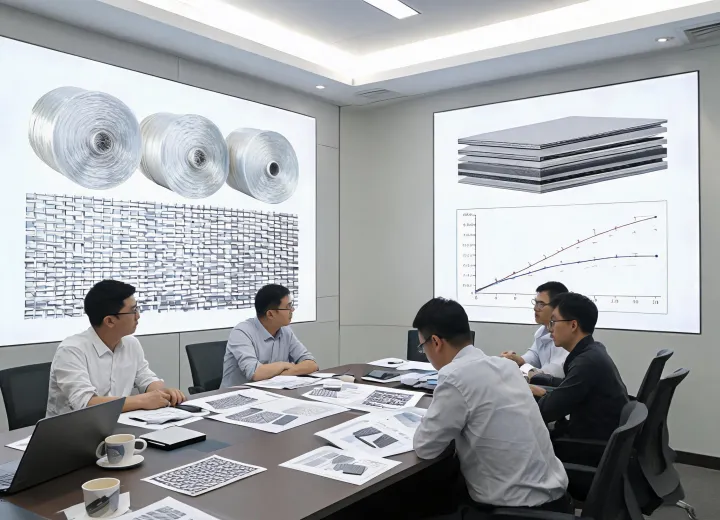
Weave, warp/weft or multiaxial orientation, stitch, layer sequence, areal weight, tolerance and usable width define placement.
Resin, infusion or prepreg route, temperature, pressure, vacuum, cure, storage and out-time shape laminate results.
Method, specimen direction, conditioning, laminate manufacture, thickness, repetitions and failure mode support interpretation.
Evidence and limitations
Textile tensile, loss on ignition, moisture or areal-weight data describe defined specimens. Laminate tension, compression, shear, flex or impact results include resin, fiber volume, voids, cure and coupon preparation. They are not material constants for every process.
Production handoff records approved architecture, roll width, orientation marks, sizing, roll identity, inspection, storage, accepted deviations and change triggers. Changes in fiber, yarn, sizing, stitch, areal weight, resin or route can invalidate earlier evidence.
External reports are checked by issuer, method, specimen, date and limitation. Compliance documents are checked by covered entity, product scope and validity. No customer, owned facility, certificate, patent or production capacity is inferred where brand assets are unavailable.
Prepreg adds resin content, tack, backing, storage temperature, shelf life and out-time. Dry reinforcement adds wet-out, permeability and resin compatibility questions. These formats require different receiving and process controls.
Receiving inspection captures roll damage, contamination, moisture, orientation marking, splice rules and traceable labels. Cutting and kitting preserve fiber direction and prevent gaps, overlaps or distorted architecture from being hidden in the stack.
Change control determines whether a new yarn, sizing, stitch, resin, cure or supplier route requires a process panel and renewed coupons. Appearance and nominal areal weight do not establish equivalence; design and component qualification remain with the responsible engineering authority.