Infrastructure strengthening
Substrate, fiber direction, anchorage, resin, surface preparation, environment and design method govern the system. Dry textile strength is not the installed structural capacity.
Architecture and test context for infrastructure, transport, industrial and energy components.
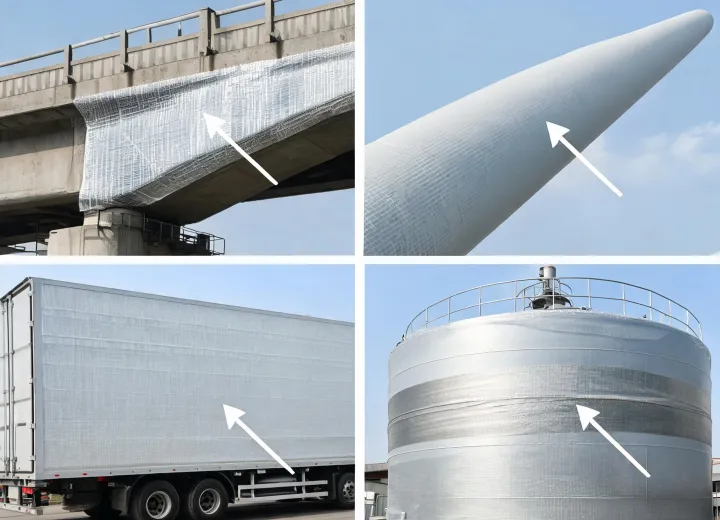
Substrate, fiber direction, anchorage, resin, surface preparation, environment and design method govern the system. Dry textile strength is not the installed structural capacity.
Weight, stiffness, crash, surface, cycle time, flame and joining requirements interact with orientation, resin, core and process.
Long fiber paths, infusion, fatigue, defects, thickness and environmental exposure require process-specific laminate evidence.
Chemical environment, pressure, temperature, corrosion barrier, joints and inspection determine the reinforcement and resin system.
| Choice | Potential advantage | Constraint | Verification |
|---|---|---|---|
| Woven vs multiaxial | Handling balance or tailored orientation. | Crimp versus stitch, permeability and stability. | Process panel and directional laminate coupons. |
| Higher areal weight | Fewer plies or faster buildup. | Drape, wet-out, voids and thickness control can change. | Forming and process trial on representative geometry. |
| UD vs balanced fabric | Fiber concentrated along a primary load. | Transverse handling, placement and off-axis loads. | Layup inspection and multidirectional design allowables. |
| Dry textile vs prepreg | Different process control and production routes. | Infusion variables versus storage, out-time and cure. | Applicable manufacturing and aged material tests. |
Engineering design remains application-specific. Coupon data does not replace analysis of geometry, joints, defects, environment, safety factors and production variation.
Material substitutions require review of fiber, architecture, sizing, resin, thickness and process. Equivalent areal weight or appearance does not establish equivalent laminate behavior.
Environmental conditioning can include heat, moisture, chemicals, UV, freeze-thaw or fatigue according to the component. Method, orientation and exposure sequence must represent the design question; initial coupons do not establish long-term field behavior.
Production controls can include roll inspection, kitting direction, ply placement, gap and overlap limits, vacuum, resin mix, cure, thickness, void assessment and traceability. The responsible engineer determines acceptance and safety factors.